

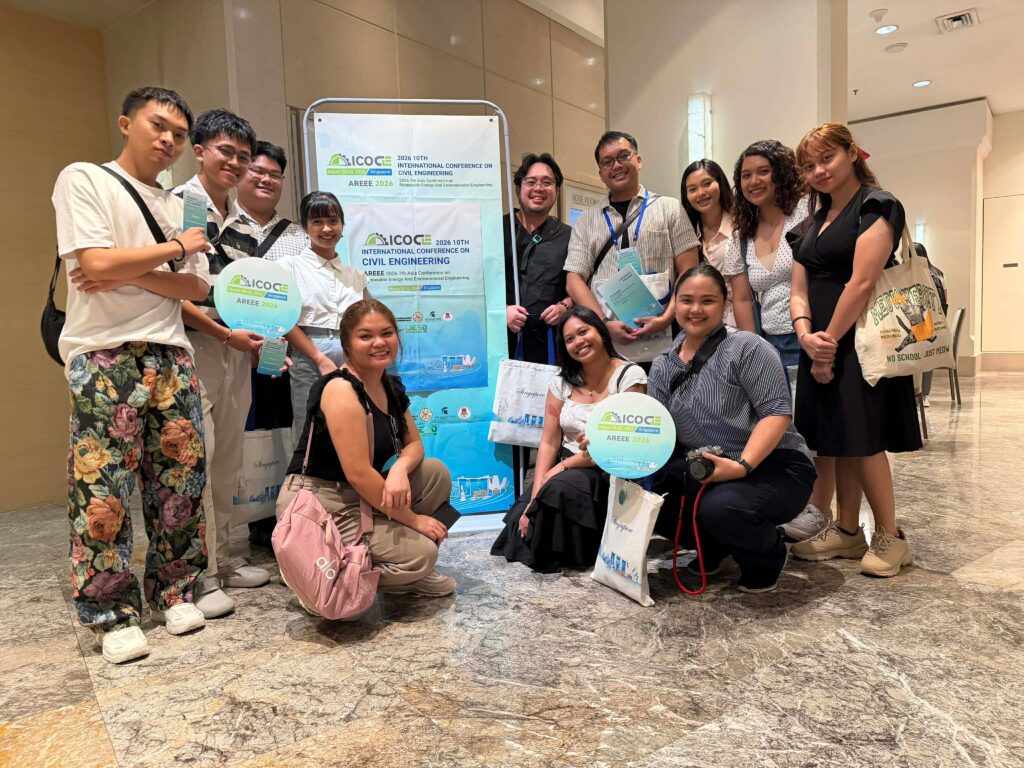
From left to right: Christian Kent Gerona, Jojit Millanes John Michael Kho, Alexandra Malcampo (instructor), Raphaella Angela Raga, Martinee Llemit (instructor), Jon Alessandra Yamas, Prinz Socriele Arce (instructor), Josah Marie Pesaña (instructor), Krystyna Marie Franada, Syd Clarrese Galiza, and Mary Christine Perono in the 11th International Conference on Civil Engineering.
Mapúa Malayan Colleges Mindanao (Mapúa MCM) strengthened its international research engagement as faculty members and Bachelor of Science in Architecture (BSA) students participated in the International Conference on Civil Engineering (ICOCE) 2026, held from March 28 to 30, 2026, at York Hotel Singapore in Singapore.
The conference brought together researchers, engineers, architects, scholars, faculty members, students, and conference delegates from various countries to share recent developments, research findings, and innovations in civil engineering and related disciplines. The conference provided an avenue to the presenters for their research to an international audience while gaining valuable perspectives from researchers and professionals in the field.
Representing Mapúa MCM were Research Professors Ar. Alexandra Malcampo, Ar. Josah Marie Pesaña, and Ar. Martinee Llemit, together with BSA students Mary Christine A. Perono, Raphaella Angela R. Raga, Jon Alessandra A. Yamas, John Michael Y. Kho, Christian Kent B. Gerona, and Jojit A. Millanes Jr.
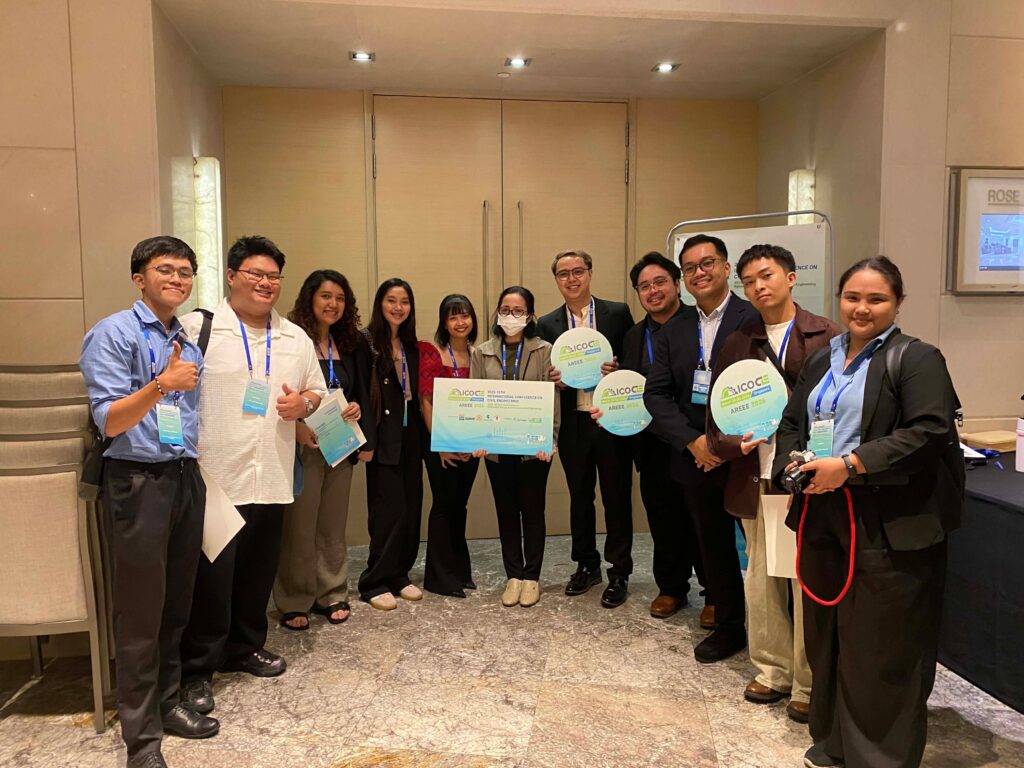
From left to right: Jojit A. Millanes Jr., John Michael Y. Kho, Syd Clarresse S. Galiza, Krystyna Marie C. Franada, Ar. Alexandra B. Malcampo, followed by two representatives from Mapúa Malayan Colleges Laguna (names unavailable), Ar. Martinee Llemit, Ar. Prinz Scoriele P. Arce, Christian Kent B. Gerona, and Ar. Josah Marie V. Pesaña.
Nine research papers involving Mapúa MCM faculty members and students were accepted for presentation and publication at the conference, covering topics related to inclusive architecture, urban planning, environmental design, accessibility, coastal development, and safety.
Among the studies were “Toward a Secular Design Framework for Inclusive Cemetery Architecture in Pluralistic Societies,” authored by Ar. Alexandra B. Malcampo and Syd Clarresse Galiza, and “The Role of Secular Design in Fostering Inclusivity and Cultural Sensitivity in Contemporary Cemetery Architecture,” by Syd Clarresse Galiza and Ar. Alexandra B. Malcampo. Both studies explored approaches to cemetery architecture that consider inclusivity, cultural sensitivity, and the diverse needs of communities.
The research also examined urban environments and public spaces. “Street Food Environments as Social Infrastructure: Implications for Urban Space and Planning in Davao City,” authored by Krystyna Marie C. Franada, Nikko D. Zamora, and Ar. Alexandra B. Malcampo, looked into the role of street food environments in relation to urban space and community life. Meanwhile, “Modeling User Demand for Urban Hiker-Cyclist Way Stations Using Survey-Derived Temporal and Spatial Patterns,” by Lech Jeon Monnec L. Sulapas and Ar. Josah Marie Pesaña, focused on understanding user demand and movement patterns to inform the planning of urban facilities for hikers and cyclists.
Accessibility and inclusive environments were further explored in “Integrating Placemaking Principles in Inclusive Live-Work-Play Environments for Persons with Disabilities,” authored by Rod Gilrey F. Fundar and Ar. Martinee L. Llemit. The study considered how placemaking principles can contribute to more inclusive environments that respond to the needs of persons with disabilities.
Two studies focused on rural coastal communities and development. “Urban Acupuncture as a Spatial Planning Strategy for Rural Coastal Revitalization: A Case Study of Barangay Buson, Philippines,” and “Community-Led Rural Coastal Regeneration through Architectural Interventions: Integrating Livelihood, Ecotourism, and Social Infrastructure in Barangay Buson, Philippines,” were both authored by Vincent Carlo S. Castrodos, Ar. Prinz Socriele P. Arce, and Ar. Martinee L. Llemit. The studies examined architectural and spatial planning interventions that may support coastal revitalization, community livelihoods, ecotourism, and social infrastructure.
The conference also featured two studies centered on the built environment and user experience. “Daylight Glare Assessment and Mitigation of the Tolentino 2020 Building’s East-Facing Façade in Davao City,” authored by Mary Christine A. Perono, Raphaella Angela R. Raga, Jon Alessandra A. Yamas, Ar. Alexandra B. Malcampo, and Ar. Martinee L. Llemit, examined daylight glare conditions and explored strategies for improving visual comfort within the building’s east-facing façade.
Meanwhile, “A Study of the Influence of Lighting Schemes on User Perception, Panic, and Decision-Making During Evacuation Scenarios,” was authored by Christian Kent B. Gerona, John Michael Y. Kho, Jojit A. Millanes Jr., Ar. Alexandra B. Malcampo, Ar. Martinee L. Llemit, and Aldrin H. Fernandez. The research explored how different lighting conditions can influence user perception, panic, and decision-making during emergency evacuation scenarios.
The presentation of these studies allowed the students to engage with international researchers and receive perspectives that can contribute to the further development of their work. More importantly, the experience demonstrated how undergraduate research can contribute to broader conversations surrounding architecture, safety, environmental design, and the built environment.
For Ms. Mary Christine A. Perono, 5th Year BSA, participating in ICOCE 2026 was a fulfilling opportunity to present their research on daylight glare evaluation before an international group of engineers and researchers. She shared that the experience allowed her to represent Mapúa MCM while connecting with innovative ideas in civil engineering and architecture from around the world.
Ms. Raphaella Angela R. Raga, 5th Year BSA, described the conference as an enriching experience, particularly because of the diverse research studies presented. She also appreciated the opportunity to share their findings with peers from another tropical setting and gain perspectives relevant to their career path.
Meanwhile, Ms. Jon Alessandra A. Yamas, 5th Year BSA, highlighted the diversity of ideas and approaches encountered during the conference. She shared that representing their research and institution at ICOCE 2026 broadened her understanding of the field and inspired new directions for future work.
For Mr. Christian Kent B. Gerona, 4th Year BSA, the conference was a valuable opportunity to interact and exchange ideas with students from different countries. The experience broadened his perspective and allowed him to appreciate the diverse approaches being applied within the field.
Mr. John Michael Y. Kho, 4th Year BSA, likewise found the conference both exciting and meaningful, particularly through listening to different studies, sharing their group’s research, and connecting with people in the industry as they prepare for their future careers as architects and professionals.
Mr. Jojit A. Millanes Jr., 4th Year BSA, described the experience as surreal, noting the opportunity to witness research and academic work from different parts of the world. For him, being able to participate in an international conference and experience the exchange of knowledge firsthand was both memorable and inspiring.
The participation of Mapúa MCM faculty and students in ICOCE 2026 highlights the institution’s continuing efforts to cultivate a strong research culture and provide students with opportunities to engage beyond the classroom. Through international conferences such as ICOCE, students gain exposure to global perspectives, strengthen their research and communication skills, and develop a deeper understanding of how architectural research can address real-world challenges.
The experience also reinforces the importance of academic collaboration and knowledge exchange in advancing innovation in architecture and the built environment, while supporting the United Nations Sustainable Development Goals, particularly SDG 4 – Quality Education, SDG 9 – Industry, Innovation and Infrastructure, SDG 11 – Sustainable Cities and Communities, and SDG 17 – Partnerships for the Goals.