

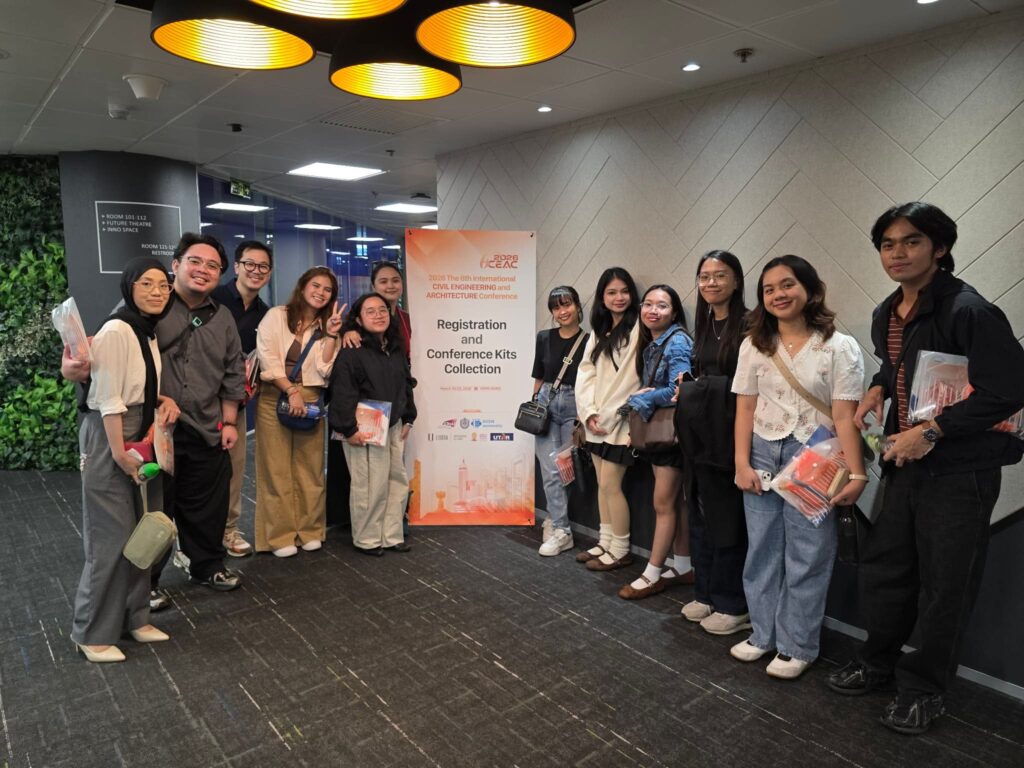
From left to right: Sohailah Batuampar, Ar. Martinee L. Llemit (Instructor), Ar. Aldrin H. Fernandez (Instructor), Ivy Faye Dianne B. Gamalong (Alumna), Anne Marie Valente, Ar. Josah Marie V. Pesana (Instructor), Alexandra Malcampo (instructor), Bau Haritz Druz Ali, Krystel Jobbie Pendon, Bea Ciara Cabahug, Isabelle Margarette Hilamon, and Kylle Bryan Balderas at the Civil Engineering and Architecture Conference (CEAC 2026).
Mapúa Malayan Colleges Mindanao (Mapúa MCM) strengthened its international research presence as faculty and Bachelor of Science in Architecture students participated in the 6th International Civil Engineering and Architecture Conference (CEAC 2026), held from March 19 to 23, 2026, at the City University of Hong Kong.
CEAC 2026 served as an international platform for researchers, architects, civil engineers, faculty members, and students to exchange knowledge and explore emerging developments in civil engineering and architecture. The conference featured keynote and invited presentations, parallel sessions, research presentations, and opportunities for academic and professional exchange.
Representing Mapúa MCM’s College of Engineering and Architecture were Ar. Alexandra B. Malcampo, UAP, and Ar. Martinee Llemit, alongside BS Architecture students Kylle Bryann A. Balderas, Sohailah S. Batuampar, Isabelle Margarette G. Hilamon, Anne Marie G. Valente, Bea Ciara B. Cabahug, Bai Haritz U. Druz Ali, and Krystel Jobbie D. Pendon.
The Mapúa MCM delegation presented eleven research papers at the international conference, covering a range of topics in architectural design, lighting, urban development, environmental conditions, cultural preservation, and community-centered architecture.
The research included “Privacy in Urban Living: A Comparative Analysis of Vertical and Horizontal Housing Models of Residents in Ma-a, Davao City,” which examined differences in privacy considerations between vertical and horizontal housing environments. This was complemented by “Anticipating Vertical Living: Age-Group Perceptions of Vertical Housing Among Residents of the Los Amigos Relocation Site, Davao City,” which explored perceptions of vertical housing among residents across different age groups.
Several studies focused on lighting and its influence on users and the built environment. These included “Lighting Conditions and Pedestrian Perception: An Integrative Assessment of Nighttime Safety Along a University Corridor in Davao City,” “A Circadian Lighting Design Framework for Night-Shift Call Center Environments,” and “Impact of Lighting Color Temperature on Consumer Behavior in Pop-Up Markets in Davao City, Philippines.” Together, these studies examined how lighting conditions, design strategies, and color temperature can influence safety, user experience, and behavior in different environments.
The delegation also presented research addressing environmental conditions and user well-being. “Noise Pollution Effects on Mental Fatigue and Noise Annoyance Among CEA-MMCU Faculty Members” examined the effects of noise exposure on mental fatigue and annoyance among faculty members, highlighting the relationship between environmental conditions and workplace experience.
Meanwhile, “Cultural Continuity and Sustainability: An Architectural Pragmatism Framework for the Evolving Urban Community of Matina, Davao City” explored approaches to sustaining cultural identity while responding to the changing needs of urban communities.
The remaining studies examined architecture as a tool for cultural preservation and community development. These included “Bale-Pamatu? Keng Quilot – Proposed Public Library Integrated Kapampangan-Caribbean Hut: Role of an Urban Catalyst in Empowering Cultural Significance: A Sense of Place Through Non-Vernacular Architecture in Angeles City, Pampanga,” and “Welfare-Oriented Community Architecture: A Kapat-Bisig Liaison in Kahirapan – Comprehensive and Integrated Delivery of Social Services (KALAHI-CIDSS) Center for Mandaya Cultural Preservation in Valencia City.” These studies considered how architectural interventions can support cultural identity, community services, and place-making.
The final study, “User-Perceived Livability Factors for Public Market Redevelopment: A Case Study of Hinatuan Public Market, Surigao del Sur,” focused on the factors that shape users’ perceptions of livability and how these considerations can inform the redevelopment of public market environments.
The research presentations provided the students with an opportunity to share their work with an international academic audience while receiving insights and feedback that can further strengthen their research. The breadth of topics presented also demonstrated the students’ engagement with architecture not only as a design discipline, but as a field connected to community development, cultural preservation, environmental quality, safety, and everyday human experience.
For the Mapúa MCM students, the conference was more than an opportunity to present research. It also served as a valuable avenue for networking, academic exchange, and exposure to perspectives from researchers, educators, and fellow students from different parts of the world.
Ar. Alexandra B. Malcampo, UAP, faculty member of the College of Engineering and Architecture, highlighted the significance of Mapúa MCM’s continued participation in international research conferences.
“Participating in CEAC for the second time highlights the growing research culture of Mapúa MCM and it also provides valuable opportunities for the students and faculty to engage with the international academic community,” she shared. She added that opportunities such as CEAC motivate students to invest greater effort in their research and gain confidence as researchers whose work can contribute to academic discussions beyond the classroom.
Similarly, Ar. Martinee Llemit emphasized how the experience strengthened the students’ understanding of architecture as a discipline that values both design and research. “This is our second consecutive participation in CEAC, and it has significantly broadened our students’ understanding of architecture as a discipline that values both design and research,” she said. “The experience has strengthened their confidence in conducting research, enriched their thesis preparation, and further expanded Mapúa MCM’s engagement with the international academic community.”
The students likewise shared how their participation broadened their perspectives and strengthened their motivation to pursue research.
Ms. Isabelle Margarette G. Hilamon, 4th Year BS Architecture, described CEAC 2026 as an opportunity to network with fellow students and industry professionals, share research, and receive recognition for their work. She said the experience renewed her motivation to continue producing meaningful research that contributes to both the academe and the global future of architecture.
For Ms. Anne Marie G. Valente, 4th Year BS Architecture, the conference offered a unique opportunity for architects, engineers, researchers, and students to exchange ideas on current and future innovations in design and technology.
Ms. Bea Ciara B. Cabahug, 4th Year BS Architecture, shared that the conference allowed her to learn about building materials, culture, and smart engineering systems from peers and professors around the world. She also valued the feedback from international professors on their research, which provided opportunities for further development and improvement.
Ms. Bai Haritz U. Druz Ali, 4th Year BS Architecture, likewise expressed her appreciation for meeting students and professors from different countries and learning from their experiences. Meanwhile, Ms. Krystel Jobbie D. Pendon, 4th Year BS Architecture, described her participation as an experience that broadened her understanding and learning in architectural and engineering design.
Through its participation in CEAC 2026, Mapúa MCM continues to provide students with opportunities to take their research beyond the classroom and engage with the international academic community. The experience reinforces the institution’s commitment to developing future-ready architects and professionals equipped with research skills, global perspectives, and a strong commitment to innovation in the built environment.
The diverse research presented at the conference further reflects the role of academic collaboration in addressing contemporary challenges in architecture and the built environment, from environmental quality and user experience to cultural preservation, community development, and sustainable urban growth.
Mapúa MCM’s participation in CEAC 2026 aligns with the United Nations Sustainable Development Goals, particularly SDG 4 – Quality Education, SDG 9 – Industry, Innovation and Infrastructure, SDG 11 – Sustainable Cities and Communities, and SDG 17 – Partnerships for the Goals.