

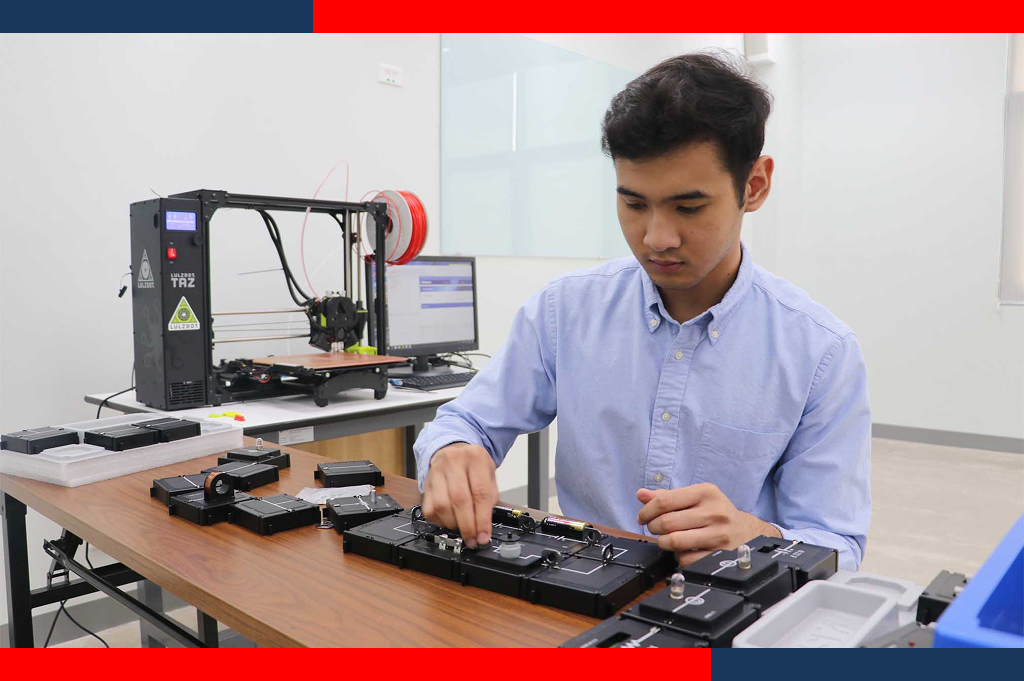
Globally competitive engineering programs are shaping future innovators right here in Mindanao—preparing students to design, build, and lead on an international stage.
For a long time, there was a common belief among students in the south: if you wanted a top-tier engineering education, you had to pack your bags and move to Manila. But things have changed. Today, Mindanao is a growing hub for industry, tech, and infrastructure, and the engineering programs available right here in Davao can match the best in the country.
Why Study Engineering in Mindanao?
Mindanao is steadily emerging as a key contributor to national development and global industry. With growing investments in infrastructure, energy, technology, and manufacturing, the demand for skilled engineers in the region continues to rise.
Institutions in Mindanao now offer programs that meet international standards, combine theory with hands-on learning, and prepare graduates for both local impact and global careers.
For example, Mapúa Malayan Colleges Mindanao (MCM) is an engineering and architecture school in Mindanao that highlights an outcomes-based education. Students are trained not only to solve equations but to understand systems—how engineering decisions affect communities, economies, and the environment. Laboratory work, simulations, collaborative projects, and industry-aligned coursework ensure that learning is practical, relevant, and aligned with global expectations.
With this foundation, let’s explore the engineering programs in college available to students in Mindanao and the career paths they unlock.
Engineering Programs Available in Mindanao
1. Civil Engineering
Civil engineering remains one of the most in-demand and impactful disciplines, especially in a developing and geographically diverse region like Mindanao. This program focuses on the design, construction, and maintenance of infrastructure that supports daily life—roads, bridges, buildings, and water systems.
Students build a strong foundation in mathematics, physics, and engineering sciences, while learning to use modern computational tools. More importantly, they are trained to design within real-world constraints, considering safety, cost, environmental impact, and sustainability.
Career Options:
- Structural Engineer, ensuring buildings and bridges are safe and durable
- Geotechnical Engineer, analyzing soil and ground conditions for construction
- Water Resources Engineer, designing systems for water supply, drainage, and flood control
2. Mechanical Engineering
Mechanical engineering is known for its versatility. This engineering program deals with the design and improvement of systems that involve motion, energy, and mechanical force, from engines and machines to heating systems and robotics.
Students learn how energy is generated, transformed, and used efficiently. Courses often cover thermodynamics, fluid mechanics, materials science, and machine design, supported by hands-on laboratory work and simulations.
Career Options:
- Aerospace Engineer, working on aircraft and aviation systems
- Automotive Engineer, improving vehicle performance and efficiency
- Energy or Power Engineer, developing sustainable and efficient energy solutions
3. Electrical and Electronics Engineering
While these two sound similar, they focus on different parts of our modern world.
Electrical engineering centers on the generation, transmission, and use of electrical energy. Students study power systems, electrical machines, and control systems that support industries and communities.
Electronics engineering, on the other hand, is an engineering program that focuses on communication technologies, ICT, networking, and robotics. It deals with circuits, signals, microprocessors, and modern communication systems.
Career Options:
- Power Systems Engineer, designing and maintaining electrical grids
- Telecommunications Engineer, supporting wired and wireless communication networks
- Robotics or Automation Engineer, developing smart and automated systems
4. Computer Engineering
We live in a world run by software, but that software needs hardware to live on. Computer engineering is an engineering program in college that serves as a bridge between the two.
Computer engineering trains students to design, build, and integrate computer systems used in everything from smartphones to industrial equipment.
Students learn programming, digital systems, microcontrollers, and network design. They also gain experience in developing smart technologies that solve real-world problems.
Career Options:
- Systems Developer, creating software for various platforms
- Embedded Systems Engineer, programming devices used in medical and smart appliances
- Network Engineer, managing secure and reliable digital infrastructure
5. Chemical and Industrial Engineering
Chemical and industrial engineering focus on optimizing processes, whether in manufacturing, services, or large-scale systems.
Chemical engineering is an engineering program that applies chemistry, physics, and material science to produce fuels, food products, pharmaceuticals, and other essential materials. Students learn how to design and control processes that transform raw materials into valuable products.
Industrial engineering focuses on improving efficiency by optimizing systems involving people, machines, materials, and energy. It blends engineering with management and decision-making.
Career Options:
- Process Engineer, improving industrial production systems
- Quality Control Analyst, ensuring products meet standards
- Logistics or Operations Manager, streamlining supply chains and workflows
Your Future Starts Here: The Mapúa MCM Advantage
Choosing Mapúa MCM means joining a community that values excellence and innovation. Our College of Engineering and Architecture (CEA) is dedicated to turning students into leaders who can compete not just in Davao, but anywhere in the world.
We use modern equipment and have mentors who are experts in their fields. But more than that, we care about the impact you make. We want our graduates to be socially responsible—engineers who think about the environment and the community while they work.
You don’t need to look far for a world-class engineering program; it’s right here in the heart of the region. By choosing Mapúa MCM, students gain more than a degree—you gain a strong foundation for leadership, innovation, and long-term success.
Are you ready to become the innovator Mindanao needs? Start your engineering career with Mapúa MCM. Your future begins here.